
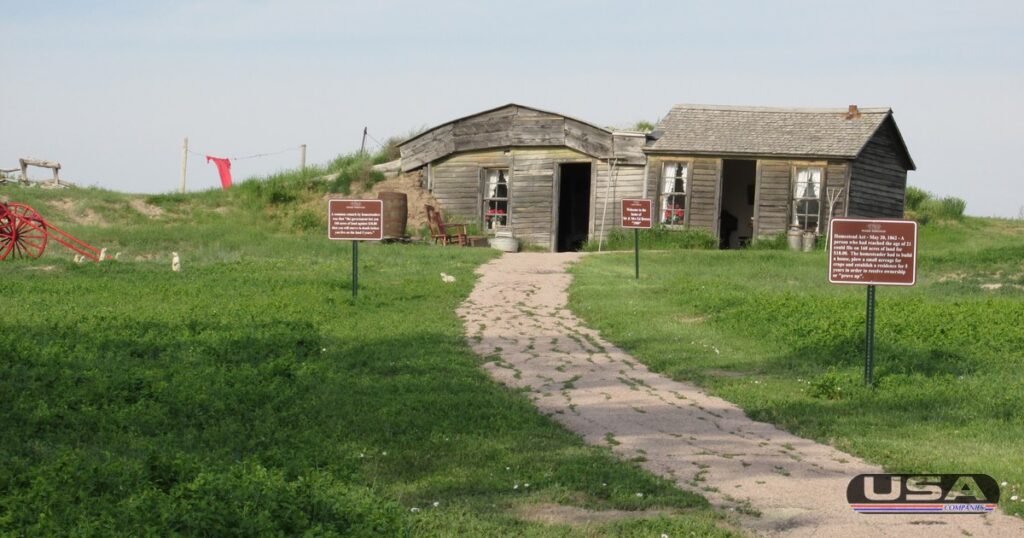
The Homestead Act
Signed by President Abraham Lincoln on May 20, 1862, the Homestead Act offered 160 acres of public land to any American citizen – or any immigrant intending to become one – who was willing to live on the land and improve it for five years. For the price of a filing fee of eighteen dollars, a person could own land outright. Over the following decades, the Act transferred more than 270 million acres of public land to private ownership and drew millions of settlers – including waves of European immigrants – into the American West.
Why It Matters
This subject carries more force when it is read in the larger American story behind it.
At The Center Of It
The Homestead Act is the most consequential single act of land transfer in American history. It democratized land ownership, created the agricultural communities that became the backbone of the Midwest and Great Plains, and gave physical form to the idea that in America, ordinary people could own the ground beneath their feet.
The Main Ideas
These sections clarify the subject, deepen it, and connect it to the larger constitutional picture around it.
Who Could Claim a Homestead
The Act was remarkably open for its era. Any head of household over twenty-one who was a U.S. citizen or had declared intent to become one – and who had never borne arms against the United States – could file a claim. This included single women, which was extraordinary for 1862. Formerly enslaved people who had been freed were technically eligible, though structural barriers, violence, and a lack of capital made successful homesteading extremely difficult for most Black Americans in the post-Civil War South and West.
The Reality of Homesteading
For most settlers, homesteading was brutally hard. The Great Plains offered few trees for lumber, water far below the surface, and weather extremes that destroyed crops with regularity. Breaking the dense prairie sod required equipment many settlers could not afford. Isolation, loneliness, and insect infestations drove many to abandon their claims. Yet millions persisted, built sod houses, drilled wells, and eventually cultivated the land that would make the American Midwest the most productive agricultural region in world history.
Its Complicated Legacy
The Homestead Act's promise was unevenly fulfilled. Native American tribes were dispossessed of ancestral lands to make homesteading possible – a displacement that was both legally and morally contested at the time and is rightly acknowledged as a profound injustice today. Land speculators manipulated the system to acquire far more than 160 acres. Despite these failures, the Act's core principle – that the land of the nation should be available to the people willing to work it – represents a genuine commitment to democratic access to economic opportunity.
Keep Moving
Use this page as a way deeper into the branch, then move outward into the related subjects that complete the picture.
Questions Worth Answering
These answers help the page stay useful to search while keeping the topic connected to its larger meaning.
How much land did the Homestead Act ultimately transfer?
Between 1862 and 1934, when the Act was effectively ended by the Taylor Grazing Act, approximately 1.6 million homestead claims were filed and about 270 million acres – roughly 10 percent of the total area of the United States – were transferred to private ownership. The peak period was between 1900 and 1920, when improved equipment and rising wheat prices made Plains farming more viable.
What was required to 'prove up' a homestead claim?
To receive the final patent – the deed to the land – a homesteader had to live on the claim for five years, build a dwelling, and make improvements such as cultivating a portion of the land. After five years, they filed for the final patent with affidavits from two neighbors confirming they had met these requirements. A faster path existed: after six months of residence, a homesteader could 'commute' the claim by paying $1.25 per acre to buy it outright.
Was the Homestead Act available to women?
Yes – any woman who was the head of a household and met the other eligibility requirements could file a homestead claim. This made the Act one of the first federal laws to formally extend a significant economic right to women on roughly equal terms with men. Single women, widows, and deserted wives all filed claims, particularly in the Dakotas, Nebraska, and Kansas. Historians estimate that women filed roughly 10 to 12 percent of all homestead claims.